Source Nitrided Welding Table with Clamps for Laser, Robot, and General Welding
Find 30 nitrided welding table with clamps options featuring adjustable turning rolls and flexible tilters. Buyers can compare steel and cast iron models with customizable sizes and hole patterns for laser, robot, and general welding applications.
Key considerations
Products List




Comprehensive Sourcing Guide
Strategic Sourcing Guide for Nitrided Welding Tables with Clamps
The global manufacturing landscape increasingly relies on precision welding fixtures to maintain efficiency and quality in automated and manual assembly lines. For procurement professionals searching for a "nitrided welding table with clamps," the objective extends beyond purchasing a simple workbench. It involves acquiring a modular, high-precision system designed to withstand the thermal and mechanical stresses of modern welding processes. This guide synthesizes observed market data and technical specifications to provide a disciplined framework for sourcing these critical assets. The focus remains on verifying attributes such as surface treatment, dimensional accuracy, and material composition to ensure the selected equipment aligns with rigorous industrial standards.
Technical Specifications and Material Composition
When evaluating a welding table, the foundational element is the material composition and the resulting mechanical properties. Observed product data indicates that high-performance welding tables are frequently constructed from Steel or Cast Iron, specifically utilizing grades such as HT300. This material selection is critical for ensuring the rigidity required to hold heavy components during the welding process without deflection. The hardness of the table surface is a key metric, with observed ranges falling between HB170 and HB300. This hardness level ensures the table can resist wear from repeated clamping and the impact of welding sparks.
The surface treatment process is equally vital for the longevity and functionality of the table. The core keyword "nitrided" refers to a specific heat treatment process that enhances surface hardness and wear resistance. In the context of the available data, the surface treatment options include Nitriding, Tempering, Carburizing, Chrome Plating, and Blackening. Nitriding is particularly valued for its ability to create a hard, wear-resistant layer without significantly altering the dimensions of the part. This is essential for maintaining the precision of the hole patterns used for clamping.
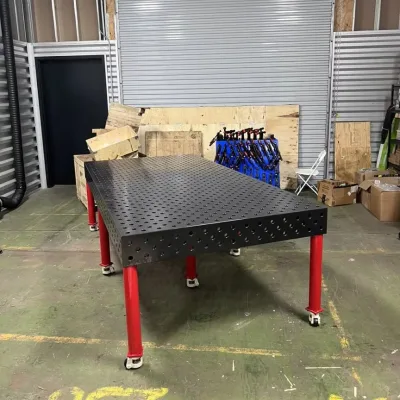
The structural design of these tables often features a platform structure with customizable dimensions. Observed models include specific configurations such as 12001200mm, 24001200*100mm, and 1500x1500x100mm. The plate thickness is another critical specification, with observed values ranging from 25mm to 30mm. Thicker plates provide greater stability and heat dissipation capabilities. The surface finish is further enhanced by the production process, which may involve casting welding or steel plate welding, ensuring a seamless and robust base for the fixture.
Precision Engineering and Hole Configuration
The utility of a welding table is heavily dependent on its hole pattern and the precision of its grid. These tables are designed to accommodate various clamping fixtures, requiring a high degree of accuracy in hole placement. The data highlights specific hole sizes, such as 28mm and 16mm, which correspond to different standard clamping systems. The hole distance, or pitch, is typically standardized at 50mm or 100mm, allowing for versatile positioning of workpieces.
Precision is not merely a suggestion but a measurable attribute. The observed tolerance for hole distance is specified as 100+-0.05mm, indicating a high level of manufacturing control. This tight tolerance ensures that clamps and fixtures lock into place securely, preventing any slippage during the welding operation. The table surface may feature four or five holes per grid unit, depending on the specific model and application requirements. The precision grade is often cited as Grade 3, which is suitable for general industrial welding applications where high repeatability is required.
For buyers, verifying these specifications is paramount. The "Hole Tolerance Distance" must be confirmed against the specific clamping tools being used. If the clamps require a 50mm pitch, the table must guarantee that tolerance within the stated limits. Additionally, the hole size must match the diameter of the clamping bolts or pins. Misalignment in these areas can lead to significant downtime and potential safety hazards. The table's ability to maintain this precision over time is a direct result of the nitriding process and the underlying material quality.
Compliance, Certification, and Standardization
In the B2B procurement of industrial equipment, compliance with international standards is a non-negotiable requirement. The sourcing guide emphasizes the importance of verifying certifications that validate the quality management systems of the supplier. The observed data confirms that many suppliers operate under ISO 9001 certification. This standard ensures that the manufacturing process is consistent, documented, and subject to regular audits, providing a baseline of quality assurance for the buyer.
Beyond general quality management, specific product standards define the dimensions and structural integrity of the welding tables. Observed standards include codes such as D28, D16, and specific dimensional models like 1200*1200 or 1000x1200x200. These codes often refer to the series of the table, indicating the hole size and grid configuration. Buyers must ensure that the product standard listed on the datasheet matches the physical requirements of their production line. For instance, a standard labeled "1000x1200x200" implies a specific footprint and height, which must be compatible with the available floor space and ergonomic requirements of the operators.
While some background information mentions CE certification, this should be treated as a potential attribute rather than a guaranteed fact for every listed product. Buyers should explicitly request proof of CE compliance if their target market or internal safety protocols require it. The origin of the products is consistently noted as China, which is a major hub for manufacturing these types of industrial fixtures. However, the country of origin does not dictate quality; rather, the specific certifications and adherence to the stated standards do.
Cost Drivers and Procurement Economics
Understanding the cost structure of nitrided welding tables is essential for budgeting and negotiation. The price range observed in the market is broad, spanning from 10 USD to 8500 USD. This variance is driven by several factors, including the size of the table, the thickness of the plate, the complexity of the surface treatment, and the inclusion of accessories. A basic 1200*1200mm table with standard nitriding will cost significantly less than a large, custom-configured unit with advanced surface treatments like chrome plating.
The minimum order quantity (MOQ) is a critical economic factor. The data indicates an MOQ of 1 unit for many suppliers, which is highly favorable for small to medium enterprises or for initial prototyping phases. This flexibility allows buyers to test the equipment before committing to larger orders. However, for bulk procurement, buyers should inquire about volume discounts, as the unit price may decrease with larger quantities.
Packaging is another cost driver that affects the final landed cost. Products are typically shipped in foreign trade wooden boxes or standard export packages. These packaging methods are designed to protect the precision surfaces of the table during international transit. Buyers should verify that the packaging includes adequate bracing and moisture protection to prevent rust or damage, especially given the high value of the nitrided surface. The inclusion of accessories, such as clamps and fixtures, can also significantly impact the total cost. Some listings include these as standard, while others may require them as separate line items.
Typical Applications and Operational Versatility
The versatility of nitrided welding tables makes them suitable for a wide range of industrial applications. The primary usage observed is for laser welding, where precision and stability are paramount. The flat, hard surface of the table provides an ideal base for laser welding heads to operate without interference. Additionally, these tables are extensively used in robot welding applications, where automated arms require a consistent and reliable workpiece positioning system.
The table's design supports various welding processes, including manual welding, assembly, and fabrication. The adjustable nature of the welding turning rolls and the flexible combination of welding tilters allow for multi-angle positioning of the workpiece. This is particularly useful for complex assemblies that require welding from multiple orientations. The tilting angle can range from 0 to 90 degrees, providing significant flexibility in how the workpiece is presented to the welding torch.
For buyers, understanding the specific application is crucial for selecting the right model. A table designed for light-duty laser welding may differ in plate thickness and hole pattern from one intended for heavy structural steel fabrication. The "Industry" classification often includes robot welding, suggesting that these tables are compatible with automated systems. The presence of accessories like clamps and fixtures further enhances the table's utility, allowing for quick changeovers between different jobs.
Supplier Evaluation and Quality Control
Selecting the right supplier requires a rigorous evaluation process that goes beyond price comparisons. Buyers should prioritize suppliers who can provide detailed documentation of their production processes. The observed data mentions specific production methods such as casting welding and steel plate welding. Verifying that the supplier uses these processes correctly ensures the structural integrity of the table.
Quality control should focus on the verification of the nitriding process. Buyers should request test results or certificates that confirm the hardness levels (HB170-300) and the uniformity of the surface treatment. The precision of the hole pattern must also be verified through dimensional inspection reports. A supplier that is transparent about their quality control measures, including the use of ISO 9001 standards, is more likely to deliver consistent products.
The customization options available from suppliers are another indicator of their capability. The ability to customize the size, hole pattern, and surface treatment suggests a flexible manufacturing process. Buyers should engage with suppliers to discuss their specific requirements, such as custom dimensions or specialized hole configurations. The lead time and location of the supplier are also factors to consider, although specific lead times should be confirmed directly with the supplier rather than assumed.
Long-Term Procurement and Maintenance Considerations
Investing in a nitrided welding table is a long-term decision that requires consideration of maintenance and lifecycle costs. The nitriding process provides a durable surface that resists wear and corrosion, reducing the need for frequent replacement. However, regular maintenance is still necessary to ensure optimal performance. Buyers should establish a maintenance schedule that includes cleaning the table surface to remove welding spatter and checking the clamping fixtures for wear.
The availability of replacement parts and accessories is another critical factor. Since the tables are designed to be modular, the ability to source compatible clamps and fixtures is essential. Buyers should verify that the supplier or the market offers a wide range of accessories that fit the specific hole pattern of the table. The "Welding Turning Rolls Type" being adjustable and the "Welding Tilter Type" being a flexible combination are features that enhance the long-term utility of the system.
Finally, buyers should consider the scalability of their procurement strategy. As production needs grow, the ability to add more tables or expand the existing setup is important. The modular nature of these welding tables allows for easy expansion, making them a scalable solution for growing manufacturing operations. By focusing on quality, precision, and supplier reliability, buyers can ensure that their investment in nitrided welding tables delivers value over the long term.
FAQs
What material is used for nitrided welding tables?
These tables are constructed from Steel or Cast Iron, specifically utilizing grades like HT300. This material selection ensures the rigidity required to hold heavy components without deflection during the welding process.
How is the surface treated to ensure durability?
The surface undergoes a nitriding process to enhance hardness and wear resistance. Additional treatments may include tempering, carburizing, chrome plating, or blackening to protect against welding sparks and clamping wear.
Which hole sizes are available for clamping fixtures?
Standard hole sizes include 28mm and 16mm to accommodate various clamping systems. The hole distance is typically standardized at 50mm or 100mm with a precision tolerance of 100+-0.05mm.
Can the welding table dimensions be customized?
Yes, customization is available for size, plate thickness, and hole patterns. Observed models range from 1200*1200mm to larger configurations like 2400*1200*100mm with plate thicknesses of 25mm or 30mm.
What certifications do these welding tables typically hold?
Many suppliers operate under ISO 9001 certification to validate their quality management systems. While CE is mentioned in background data, buyers should explicitly request proof of compliance if required for their market.
How does the tilting angle affect welding operations?
The tilting angle ranges from 0 to 90 degrees, allowing for multi-angle positioning of workpieces. This flexibility is essential for complex assemblies requiring welding from different orientations using flexible combination tilters.
What is the minimum order quantity for these tables?
The minimum order quantity is 1 unit, which is favorable for small enterprises or prototyping. This allows buyers to test the equipment before committing to larger orders or bulk procurement.